



Yueqing, Zhejiang, November 2026 — Rimu Wire & Cable Co., Ltd. has consolidated its high-flex cable programme for robotics and unmanned aircraft, covering drag chain cables TRVV and TRVVP, robot body cables JTEUSP and JTEUP, drag chain designs JBEUSP and JBEUP, and the MIL-1394B aerospace high-speed data bus.
The demand behind the range is easy to see. Cobots now share cells with operators in electronics and battery assembly, autonomous mobile robots move pallets between stations, and inspection and delivery drones fly daily routes. In each case the cable is the part that moves most and gets specified last. A cable chosen for its current rating alone may pass the first bench test and still fail within its first year in service, because what breaks in a robot joint is not the voltage but the repeated bending of copper strands at the same point.
Bend life is decided at the conductor
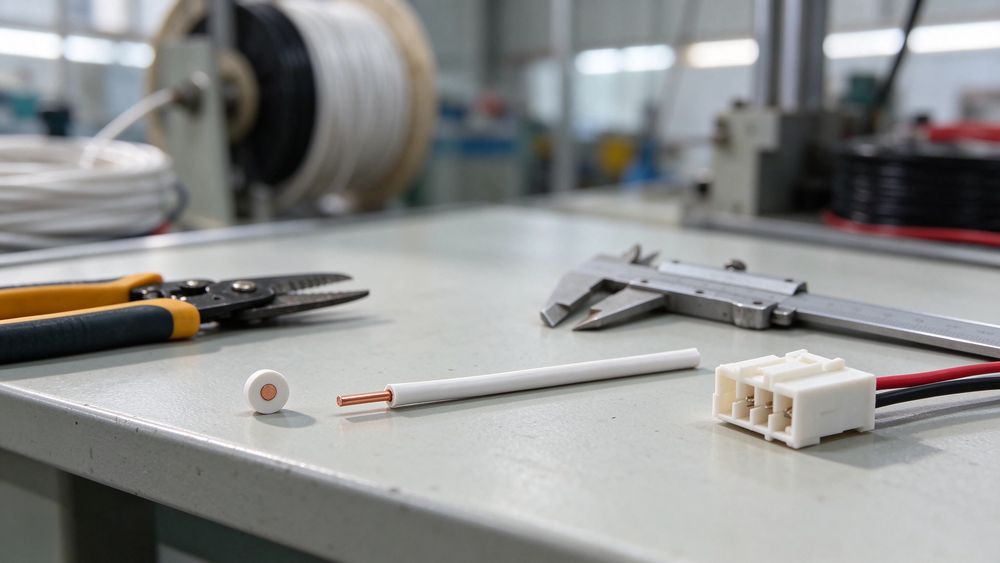
Flexibility is not a jacket property. It starts in the conductor, where many fine strands share the bending load instead of a few coarse ones, and continues through the lay length, the insulation compound and the way the finished core is cabled. Short lay lengths spread elongation along the axis; a stiffer insulation saves space but raises the force the joint has to carry; a smooth, low-friction jacket reduces the abrasion that wears through a core after hundreds of thousands of chain cycles. Shielded versions add a further trade — coverage against EMI in a servo-driven cell costs stiffness, so the braid or foil has to be chosen against the actual noise environment rather than by default.
Four designs, one specification route
| Design | Typical duty | What the specification fixes |
|---|---|---|
| TRVV / TRVVP drag chain cable | Cable carriers on machine tools and automation cells; TRVVP adds shielding | Strand construction, lay length, jacket friction, bending radius |
| JTEUSP / JTEUP robot body cable | Joint and wrist routing inside a robot arm | Torsion and bend combination, outer diameter for joint clearance |
| JBEUSP / JBEUP drag chain cable | Long-travel carriers and linear axes | Travel length, chain speed, acceleration, cable weight |
| MIL-1394B data bus | Aerospace and defence high-speed links | Impedance, shielding and pair geometry |
Behind these designs sits the wider material library the company works from: Teflon, silicone rubber, fiberglass braided, PI, PEEK, ETFE, PU and PVC compounds, with UL styles, CCC and CE approvals available across the range. For drone programmes the same library is used the other way round — thin-wall insulation and lightweight conductors to cut grams at the wing or gimbal, balanced against the abrasion the cable meets on landing.
Approval before volume, not after
Rimu runs ISO 9001 quality management, ISO 14001 environmental management and ISO 45001 occupational health and safety systems, and holds UL, CE and CCC certification on the product lines it supplies abroad. For a robot or drone project the sequence is the same as for the company's other special cable work: confirm the duty cycle, route and environment, build a sample to the agreed specification, then release volume production against the approved sample and written specification. Harness assembly and terminal processing can be added to the cable so the customer receives a tested sub-assembly rather than a reel.
The company has supplied custom cable to leading manufacturers in China and overseas since it was founded in Liushi, Yueqing in 2008, and was named a Star Enterprise by Liushi Town Government for 2025 — the fourth consecutive year it has received the award.
For buyers comparing high-flex suppliers, the practical question is not how many strands a catalogue lists but whether the sample that arrives has been built to the same specification that will be produced. That is the point where bend life is won or lost.